
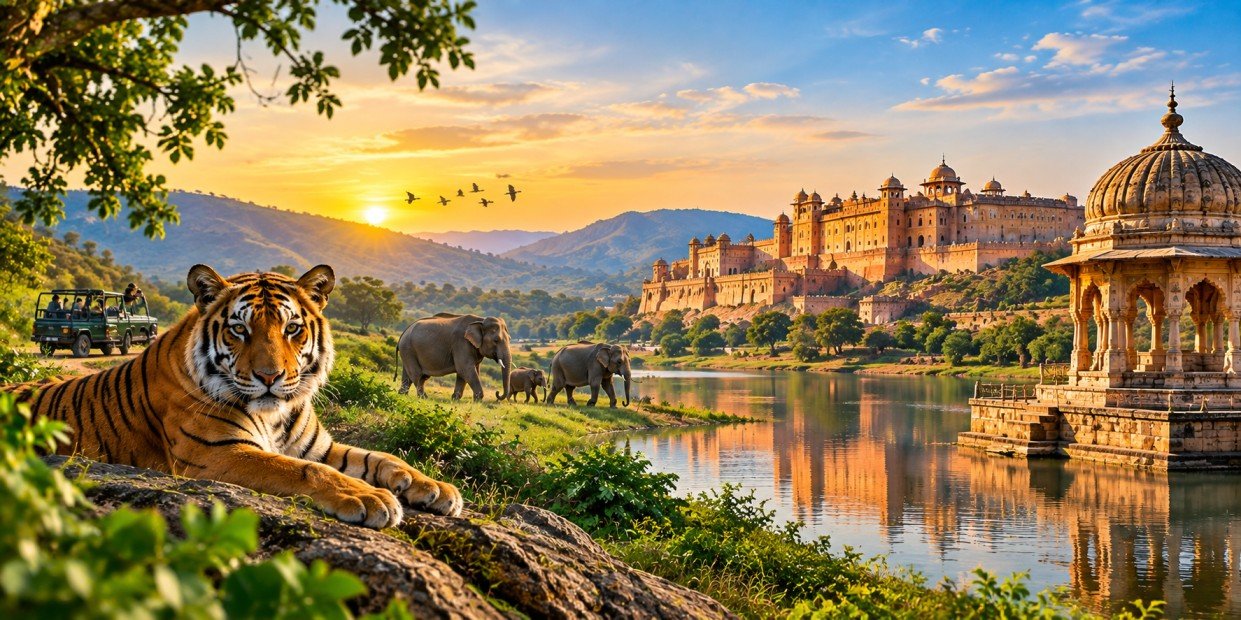
Ask ten travellers what 'real India' means to them, and you'll likely get ten different answers. For some, it's standing inside a centuries-old fort, tracing carvings that have survived empires. For others, it's the hush inside a jeep as a tiger crosses the trail a few metres away. The truth is, India doesn't ask you to choose between the two. Its wildlife and heritage sit close together, often just a few hours' drive apart, and seeing both is what makes a trip here feel complete rather than curated.
This guide walks through the best destinations for India Wildlife Tours and heritage experiences, and how to weave them into one trip instead of picking just one.
Why India Is Best Explored Through Wildlife and Heritage Together
India's geography works in your favour here. Rajasthan alone has both tiger reserves and some of the world's grandest forts within a day's drive of each other. Madhya Pradesh pairs dense sal forests with ancient temple towns. Even a short trip can realistically include a safari morning and a heritage walk in the same week, without long transfers eating into your holiday. This is what separates a checklist tour from one that actually shows you how the country lives, works, and has evolved.
Top Destinations for India Wildlife Tours
Ranthambore National Park, Rajasthan
One of India's most famous tiger reserves, Ranthambore National Park is unique because the wildlife and heritage overlap literally, a 10th-century fort stands inside the park itself, with tigers often seen walking past its ruined walls. It's an easy add-on if you're already doing a Rajasthan or Golden Triangle circuit.
Jim Corbett National Park, Uttarakhand
India's oldest national park, Jim Corbett National Park combines tiger sightings with the cooler foothills of the Himalayas. It's a good choice if you want your safari trip paired with a quieter, scenic landscape rather than a desert or grassland setting.
Kaziranga National Park, Assam
Kaziranga is home to the majority of the world's one-horned rhinoceros population, along with elephants, wild buffalo, and tigers. Set in Assam's lush floodplains, it offers a completely different ecosystem from central India's dry deciduous forests, along with the region's distinct tea-country culture nearby.
Top Destinations for India Heritage Tours
Rajasthan's Forts and Palaces
Rajasthan is arguably India's richest state for heritage travel, Amber Fort in Jaipur, Mehrangarh in Jodhpur, and the City Palace in Udaipur each tell a different chapter of Rajput history. Combine this with a wildlife stop at Ranthambore, and you get a trip that captures both royal history and raw nature in one state.
The Golden Triangle: Delhi, Agra, Jaipur
No India heritage itinerary feels complete without the classic Golden Triangle Tour, the Taj Mahal in Agra, Delhi's blend of Mughal and colonial architecture, and Jaipur's pink sandstone forts. It's the most accessible heritage circuit for first-time visitors and pairs naturally with a Ranthambore safari extension.
South India's Temple Trail
For a different flavour of heritage, South India's temple towns, think Madurai, Thanjavur, and Hampi, offer Dravidian architecture, living temple traditions, and a culture that has stayed remarkably continuous for over a thousand years. It's less crowded than the northern circuit and worth considering if you're returning for a second India trip.
How to Combine Wildlife and Heritage in One Trip
The easiest way to plan this is to pick one state or region as your base and build outward. Rajasthan, for instance, lets you cover Jaipur's palaces, Ranthambore's tigers, and Jodhpur's blue city within a 10-12 day loop. Madhya Pradesh similarly combines Khajuraho's temples with Bandhavgarh and Kanha's tiger reserves. Rather than treating wildlife and heritage as two separate trips, think of them as two halves of the same regional story.
● Group destinations by geography first, then by experience type
● Keep 2-3 nights minimum at each wildlife stop for multiple safari attempts
● Balance heritage-heavy days (lots of walking) with a slower safari day in between
● Use a local guide or naturalist at both heritage sites and wildlife parks, context adds a lot to both
Best Time to Plan a Wildlife and Heritage Tour
October to March is the sweet spot for most of India, cooler weather makes both fort-hopping and safari mornings far more comfortable. Wildlife parks are also closed during the monsoon months (roughly July to September) for breeding season, so plan around this if a safari is central to your trip. Heritage sites remain open year-round, so they're more forgiving if your dates land outside the ideal wildlife window.
Tips for Planning Your Wildlife and Heritage Trip
● Book wildlife safaris well in advance, permits are limited and sell out fast in peak season
● Dress in neutral colours for safaris, but pack breathable, modest clothing for temple and heritage visits
● Hire local guides at heritage sites, a lot of the history isn't visible on the surface
● Build in a rest day between long heritage walks and early-morning safaris to avoid travel fatigue
Final Thoughts
India rarely fits neatly into one theme, and that's exactly its appeal. A trip that mixes a tiger safari with a walk through a centuries-old fort gives you both the wild and the historic sides of the country, and honestly, a much fuller sense of what makes it worth visiting in the first place.
If you'd like help designing a trip that blends wildlife and heritage without the back-and-forth planning, get in touch with our travel experts, and we'll put together an itinerary suited to your dates, interests, and pace.